 EMFCALM
5G and health: what we know and what we don't
WHO says no adverse health effect has been causally linked to wireless technologies, the FDA says the weight of evidence has not linked cell phone radio waves with health problems, and the FCC kept its limits in 2019. The thin part is research at 5G's higher frequencies, which WHO says only "a few studies" have looked at. And in 2021 a federal appeals court told the FCC to better explain why its limits protect against health effects other than cancer.
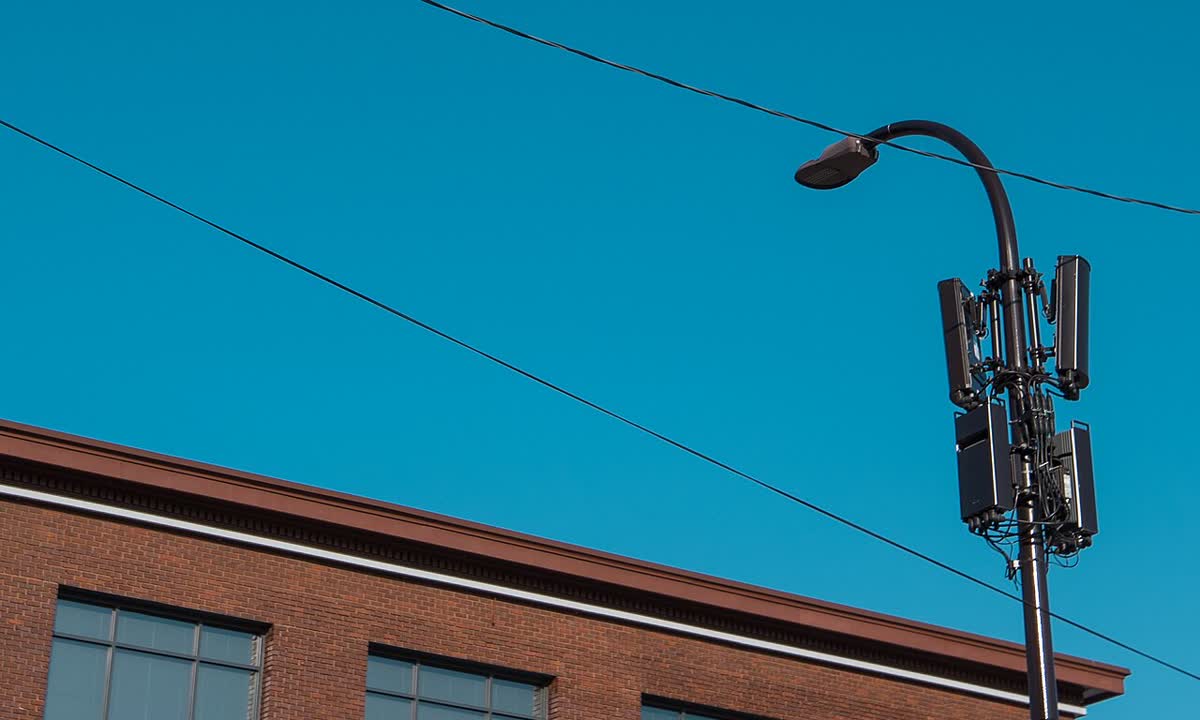
This guide sticks to what the primary documents say, and it isn't medical advice. For the wider picture on phones, see our overview of what agencies say about cell phone radiation.
Which frequencies does 5G use in the US?
The FCC's 5G FAST Plan sorts 5G spectrum into low, mid and high bands. Low-band is 600, 800 and 900 MHz, which the plan calls "useful for wider coverage." Mid-band is 2.5 GHz, 3.5 GHz and 3.7-4.2 GHz. High-band is millimeter-wave spectrum: 24 and 28 GHz, plus the upper 37, 39 and 47 GHz bands. It also names unlicensed spectrum at 6 GHz and above 95 GHz for the next generation of Wi-Fi, which our router guide covers. And it talks about small cells, the compact sites 5G needs "as opposed to large cell towers."
Between 2017 and 2022 the FCC auctioned licenses in all three groups, and the chart shows where each band tops out. The dashed line sits at 6 GHz, where US rules change how a phone gets tested.
GHz. Bands from the FCC's 5G FAST Plan; the year in parentheses is when bidding closed (2017 to 2022). Each bar ends at the band's upper edge; the label shows the full range.
| Band (bidding closed) | Frequency range |
|---|---|
| 600 MHz, low-band (2017) | 0.617-0.698 GHz |
| 2.5 GHz, mid-band (2022) | 2.496-2.690 GHz |
| 3.45 GHz (2022) | 3.45-3.55 GHz |
| 3.5 GHz CBRS (2020) | 3.55-3.65 GHz |
| 3.7 GHz C-band (2021) | 3.70-3.98 GHz |
| 24 GHz, high-band (2019) | 24.25-25.25 GHz |
| 28 GHz (2019) | 27.50-28.35 GHz |
| Upper 37 and 39 GHz (2020) | 37.6-40.0 GHz |
| 47 GHz (2020) | 47.2-48.2 GHz |
Sources: FCC auction fact sheets for Auctions 101, 102, 103, 105, 107, 108 and 110; 600 MHz band from 47 CFR 27.5 and the FCC incentive auction closing notice (April 13, 2017); band groups from the FCC 5G FAST Plan; 6 GHz line from 47 CFR 2.1093. Dashed line: 6 GHz, above which US rules test a phone by power density instead of SAR.
The 28 GHz band is roughly 40 times higher in frequency than the 600 MHz band. WHO notes that frequencies this high are new to mobile networks but "commonly used in other applications, such as point-to-point radio links and body-scanners for security checks."
How does the body absorb higher frequencies?
Less deeply. In WHO's words, "As the frequency increases, there is less penetration into the body tissues and absorption of the energy becomes more confined to the surface of the body (skin and eye)."
The ICNIRP 2020 guidelines give the numbers. (Many countries follow ICNIRP guidelines, per WHO.) Below about 6 GHz, fields "penetrate deep into tissue," so ICNIRP measures exposure as SAR, the power absorbed per kilogram. Above 6 GHz they "are absorbed more superficially," so it uses absorbed power density, watts per square meter of surface. At 6 GHz, 86% of the power is absorbed within 8 mm of the surface. At 300 GHz the same share is absorbed within 0.2 mm.
- 8 mm
- depth that holds 86% of the absorbed power at 6 GHz
- 0.2 mm
- depth that holds the same share at 300 GHz
- 6 GHz
- where US rules switch phone testing from SAR to power density
- 1.0 mW/cm²
- FCC public limit from 1.5 to 100 GHz, 30-minute average
Figure 2. Sources: ICNIRP guidelines, 2020, citing Sasaki et al. 2017; 47 CFR 1.1310 and 2.1093, current text read November 9, 2026.
US rules switch at the same point. 47 CFR 1.1310 uses SAR from 100 kHz to 6 GHz, and above 6 GHz its power-density limits "shall be used in all cases." A companion rule, 47 CFR 2.1093, applies that split to phones. So a phone on mid-band 5G faces the same SAR limit as any other phone below 6 GHz, 1.6 W/kg averaged over 1 gram of tissue.
The public power-density limit is f/1500 mW/cm² from 300 to 1,500 MHz, with f in MHz. Above that, up to 100 GHz, it's a flat 1.0 mW/cm² averaged over 30 minutes. That works out to 10 W/m², the same whole-body level ICNIRP set for the public from 2 to 300 GHz.
| Band | Frequencies | Bidding closed | How a phone is tested | FCC public limit (30-min average) |
|---|---|---|---|---|
| 600 MHz (low-band) | 617-652 and 663-698 MHz | April 2017 | SAR, 1.6 W/kg over 1 g | 0.41-0.47 mW/cm² |
| 2.5 GHz (mid-band) | 2496-2690 MHz | August 2022 | SAR | 1.0 mW/cm² |
| 3.45 GHz | 3450-3550 MHz | January 2022 | SAR | 1.0 mW/cm² |
| 3.5 GHz (CBRS) | 3550-3650 MHz | August 2020 | SAR | 1.0 mW/cm² |
| 3.7 GHz (C-band) | 3700-3980 MHz | February 2021 | SAR | 1.0 mW/cm² |
| 24 GHz (high-band) | 24.25-24.45 and 24.75-25.25 GHz | May 2019 | Power density | 1.0 mW/cm² |
| 28 GHz | 27.5-28.35 GHz | January 2019 | Power density | 1.0 mW/cm² |
| Upper 37 and 39 GHz | 37.6-40 GHz | March 2020 | Power density | 1.0 mW/cm² |
| 47 GHz | 47.2-48.2 GHz | March 2020 | Power density | 1.0 mW/cm² |
Sources: FCC auction fact sheets and 2017 incentive auction notice; 47 CFR 27.5, 1.1310 and 2.1093, read November 9, 2026. The 600 MHz limit is our f/1500 arithmetic.
What did the FCC decide in 2019?
The FCC's limits were last set in 1996. In 2013 it opened an inquiry into whether they needed changing, and it closed that inquiry in FCC 19-126, adopted November 27, 2019 and released December 4. In the order's words, "we find no appropriate basis for and thus decline to initiate a rulemaking to reevaluate the existing RF exposure limits."
The order says no expert health agency expressed concern about the limits, and it quotes an April 2019 letter from the director of FDA's device center: "no changes to the current standards are warranted at this time." It also explains why the National Toxicology Program's rodent results don't carry over to people. One reason it gave is that the studies used 2G and 3G phones and "did not study WiFi or 5G." We go through that research in our NTP study guide.
The same order rewrote the rules on which transmitters need an exposure evaluation, so that the public stays "adequately protected as new technologies, like 5G, flourish and more transmitters are deployed." It also proposed a new localized limit above 6 GHz: 4 mW/cm² averaged over 1 cm² for the general public. The current eCFR text of 1.1310 doesn't include it.
What did the court rule in 2021?
Several groups and individuals asked the US Court of Appeals for the D.C. Circuit to review the 2019 order. On August 13, 2021, in Environmental Health Trust v. FCC (No. 20-1025), the court granted the petitions in part. Judge Wilkins wrote the opinion. Judge Henderson dissented in part. The court held that:
- The order was "arbitrary and capricious in its failure to respond to record evidence that exposure to RF radiation at levels below the Commission's current limits may cause negative health effects unrelated to cancer."
- On cancer, the FCC's explanation was adequate. IARC's classification of RF radiation as "possibly carcinogenic" did not make the FCC's view arbitrary. Our IARC 2B guide explains that label.
- The FCC "completely failed even to acknowledge" comments about RF radiation and the environment.
- The petitioners lost their argument that the FCC owed a new environmental review under NEPA.
The case went back to the FCC with instructions. It has to explain why it kept its testing procedures for phones and other portable devices. It also has to address children, long-term exposure, "the ubiquity of wireless devices, and other technological developments" since its last update, and the environment.
The court spelled out what it was not deciding: "we take no position in the scientific debate regarding the health and environmental effects of RF radiation." There "may be good reasons" the studies don't warrant changes, it wrote, but the FCC has to give them.
What do the FDA and WHO say about 5G?
The FDA's cell phone page doesn't single out 5G. It says "the weight of scientific evidence has not linked cell phone radio frequency radiation with any health problems" (content current as of May 13, 2021). FDA gives the FCC scientific input, and the FCC sets the limits.
When FDA does name 5G, it's talking about medical equipment. Its device-safety research program lists "insufficient knowledge of the 5G performance characteristics necessary to ensure the safe operation of 5G-enabled medical devices" as a gap.
WHO's 5G Q&A is dated February 27, 2020. It says "no adverse health effect has been causally linked with exposure to wireless technologies," and that tissue heating is the main way RF fields act on the body, with "negligible temperature rise" from current technologies. Exposure from 5G at around 3.5 GHz "is similar to that from existing mobile phone base stations." Beam-forming antennas could make exposure vary more with where people are and how they use the network. The health answer ends on this line: "Provided that the overall exposure remains below international guidelines, no consequences for public health are anticipated." In May 2020 it also published a graphic titled "5G mobile networks DO NOT spread COVID-19."
What do the agencies say is still unknown?
Here is what each source says is still open.
| Source | What it says is still open |
|---|---|
| WHO 5G Q&A (February 2020) | Says "only a few studies have been carried out at the frequencies to be used by 5G," and any change in exposure "is still under investigation" |
| WHO, same page | A risk assessment covering 5G, "to be published by 2022." The page still shows that date. |
| FCC consumer guide (reviewed November 2020) | Those evaluating the risks agree "more and longer-term studies should explore whether there is a better basis for RF safety standards than is currently used" |
| ICNIRP guidelines (2020) | Knows of no research on how 6 to 300 GHz fields affect body core temperature, so "as a conservative measure" it applies its below-6 GHz threshold up to 300 GHz; notes "uncertainty" over the exact frequency where SAR should give way to power density |
| FDA literature review (February 2020) | Direct measurements of RF exposure "are not yet possible outside of a laboratory setting" |
None of these sources reports a harm found at or below the limits. The open items are mostly studies not yet done and exposure that is hard to measure.
What this means for a 5G phone
A phone on low-band or mid-band 5G is held to the same 1.6 W/kg SAR limit as any other phone transmitting below 6 GHz. If it also has a millimeter-wave radio, that part is checked by power density, at frequencies where WHO and ICNIRP say absorption stays near the surface of the body, mainly the skin. If you'd like less exposure anyway, our phone guide covers the free steps, like speakerphone and keeping the phone off your body.
General information about radio-frequency exposure from everyday devices. Not medical advice.